Blog
Protein That Fits Your Working Day
When work gets busy, it is easy to let meals become an afterthought. Breakfast might be a quick coffee, lunch whatever is available between meetings, and dinner the first opportunity to sit down and eat properly.
That routine can mean much of your daily protein comes from one meal, rather than being included throughout the day. While your overall protein intake is important, it is also worth thinking about when you eat it and whether your usual meals provide a good balance.
With insights from our partners at Health Labs HQ, we explore why protein distribution is worth considering, how to identify gaps in your working day and some simple ways to make protein-rich meals more convenient.
Look Beyond Your Daily Protein Total
When thinking about protein, the first question is often how much you eat across the whole day. While your overall intake matters, it is also useful to consider how that protein is spread across your meals.
A common pattern is a breakfast that contains very little protein, a rushed lunch and a larger protein-rich dinner. You might be eating a reasonable amount overall, but relatively little earlier in the day. Protein provides amino acids, which the body uses for a range of important functions, including maintaining and repairing muscle tissue. Muscle protein is continually being broken down and rebuilt, and eating protein stimulates a process called muscle protein synthesis (MPS), where the body makes new muscle protein. This is one reason researchers have looked at whether spreading protein across meals could be beneficial, rather than concentrating most of it in the evening.
It does not mean every meal needs to contain exactly the same amount, or that you need to follow a strict eating schedule. Instead, it is a reminder to look at your usual eating pattern and consider whether breakfast or lunch could benefit from a more substantial protein source.
Protein Distribution Throughout The Day
One study often discussed in relation to protein distribution was published by Mamerow and colleagues in 2014. Researchers looked at eight healthy adults who followed two different eating patterns over separate seven-day periods. Both diets provided a similar amount of protein and energy across the day. The difference was how the protein was distributed.
In one pattern, participants consumed around 30g of protein at breakfast, lunch and dinner. In the other, breakfast and lunch contained considerably less, with most of the protein eaten at dinner. The researchers measured muscle protein synthesis over 24 hours and found that the more evenly distributed pattern produced a 25% higher measured rate than the evening-heavy pattern (Mamerow et al., 2014).
Protein requirements are not the same for everyone. Research highlights the importance of total daily protein intake, particularly for those undertaking resistance training, while individual needs vary according to factors such as body size, activity levels and health goals (Morton et al., 2018).
In everyday terms, the message is simple. If most of your protein is currently eaten at dinner, it may be worth looking at what you could add to breakfast or lunch. You do not need to make every meal identical, simply being more aware of where protein appears in your day can help you make more considered choices.
Try for yourself
Our Best Selling High Protein Meals




Find the Gaps in Your Working Day
Before making changes to your diet, take a look at what you already eat. There is little point overhauling a breakfast routine that works well if the bigger gap is at lunchtime. Think about a couple of typical working days and identify the main protein source in each meal. You might have eggs or Greek yoghurt for breakfast, a sandwich or a quick snack at lunchtime, and chicken, fish or another protein source with dinner. In this case, lunch could be the meal worth focusing on.
Alternatively, you might have a reliable lunch but regularly skip breakfast because you are short on time. Your own routine is the best place to start, rather than copying somebody else’s meal plan. Once you have identified the gap, think about what would make that meal easier. Consider whether you have time to prepare something, access to a microwave or fridge, and somewhere to store food during the working day.
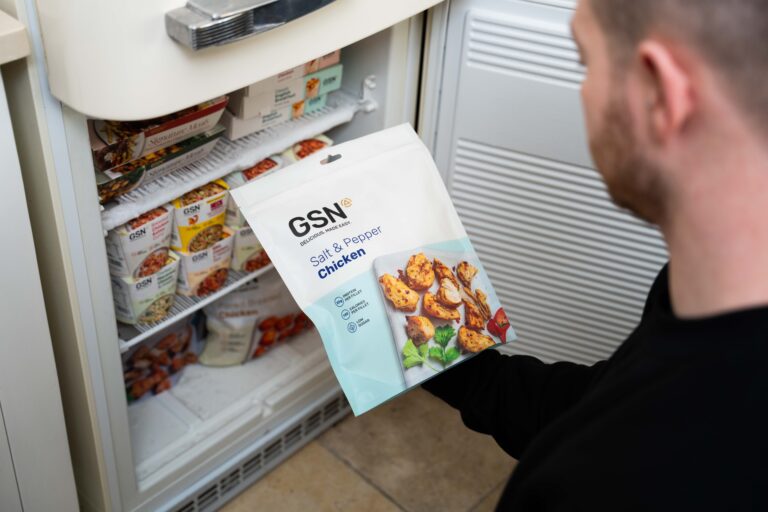
A little planning can make a difference. Deciding what you are going to eat the night before, preparing ingredients in advance or keeping a few convenient options in the freezer, such as frozen high protein ready meals, can make it easier to have something suitable available when your schedule gets busy. The aim is to find an option that fits your actual working day, not introduce another complicated task to an already full schedule.
Simple Ways to Include Protein Throughout the Day
You do not need to completely change your routine to make protein a more regular part of your meals. A few practical adjustments can help you make better use of the food you already enjoy.
If breakfast is usually just coffee or toast, consider adding eggs, Greek yoghurt, milk or another protein source. Overnight oats made with yoghurt or milk can also be prepared in advance, giving you something convenient to reach for when mornings are rushed.
Planning lunch before the working day starts can help too. Decide what you are going to eat rather than leaving it until you are hungry. A wrap, chicken salad or rice bowl can all be built around a protein source you enjoy, with vegetables and other ingredients added to make a satisfying meal.
It is also worth keeping convenient options available. Frozen wraps, ready-cooked chicken and other easy-to-prepare foods can help when time is limited. GSN’s High Protein Wraps are ready in three minutes from frozen, making them a practical option to keep in the freezer for busy days.
Variety matters as well. Chicken, fish, eggs, dairy products, beans and lentils all provide protein. Rotating different sources can help keep meals interesting and provide a wider range of nutrients. You might choose eggs at breakfast, chicken in a lunchtime wrap and beans or fish with your evening meal.
Above all, choose changes you can maintain. You do not need to hit an exact protein number at every meal or completely rethink everything you eat. Start by improving the meal where you currently have the least protein, then see whether the change works with your routine.
Make Your Eating Routine Work for You
Eating well during a busy working week does not have to mean spending hours preparing meals or following a strict plan. It is about making choices that fit your schedule and help you meet your nutritional needs.
Looking at protein distribution can be a useful starting point. Rather than focusing only on your evening meal or daily total, consider whether breakfast and lunch are providing a protein source too. Small adjustments to the meals you already eat can be easier to maintain than trying to change your entire diet at once.
The research into protein distribution offers an interesting insight into how the body responds to different eating patterns, but there is no single approach that suits everyone. Your needs will depend on factors such as your health, body size and activity levels. If you need advice on an appropriate protein intake, a registered dietitian can help.

Sam Gaunt
Health Director at Health Labs HQ
Sam Gaunt is Health Director at Health Labs HQ, where her work is rooted in Human Physiology and over 20 years of applied expertise across nutrition, stress management and sleep science, including specialist practice in Cognitive Behavioural Therapy for insomnia. Her Advanced Nutrition Diploma spans the full life course, from childhood and adult nutrition through to older adult and performance nutrition. She is also a Fellow of the Royal Society for Public Health (FRSPH). Sam spends most of her week helping busy working parents and frazzled professionals eat better, sleep better and feel more energised, so they can perform at their best and recover properly in between. She's also a long-standing GSN customer and her favourite high protein ready meal is Chicken Macaroni Cheese & Greens. Read her full credentials on her author profile.